
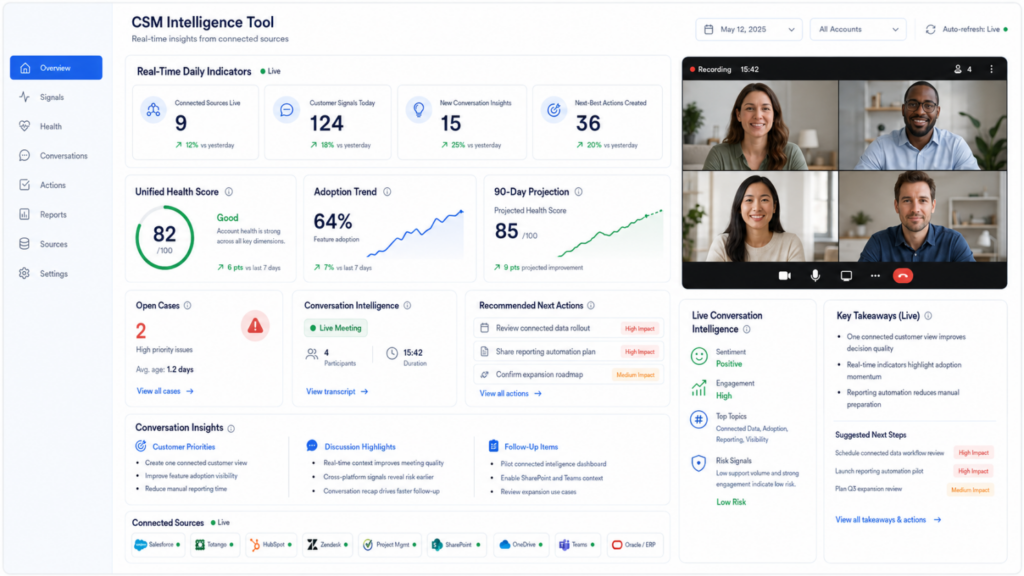
Customer Success does not have a shortage of data. It has a connection problem.
Most organizations already collect more customer information than they can effectively use. Relationship history may live in Salesforce or HubSpot. Health scores, lifecycle stages, and adoption trends may sit in Totango or another Customer Success platform. Support activity may be tracked in Zendesk. Project milestones may live in construction software, project-management tools, or industry-specific systems. Documents are stored in SharePoint and OneDrive, while meetings, decisions, and commitments are spread across Microsoft Teams, email, and call-recording platforms.
In automotive, the picture can be even more fragmented. Customer information may be distributed across dealership CRMs, dealer-management systems, digital retail platforms, service tools, training systems, and customer communication applications. In construction, the same challenge appears through CRM platforms, scheduling systems, field-service tools, estimating software, project-management applications, and financial platforms. Large enterprises may also rely on Oracle or similar ERP environments to manage contracts, billing, purchasing, operations, and financial performance.
The systems vary by industry, but the problem remains the same: each platform contains part of the customer story, while few organizations can see the entire story in real time.
That is where the next major evolution of Customer Success will happen.
The future will not be defined by adding another isolated tool to an already crowded technology stack. It will be built around an intelligent operating layer that securely connects the systems organizations already use, interprets the relationships between the data, and turns that information into coordinated action.
The Customer Story Is Already There
Every customer leaves a trail of information across the business.
A CRM may contain the relationship history, key contacts, commercial opportunities, and commitments made during the sales process. A Customer Success platform may show health scores, success plans, product adoption, and renewal risk. A support platform may reveal unresolved cases, recurring issues, resolution times, and customer frustration.
Project-management systems may show delayed milestones, missed dependencies, or incomplete deliverables. Meeting notes may contain business objectives that were never added to the official account record. SharePoint and OneDrive may hold executive business reviews, contracts, account plans, training materials, and implementation documents. Microsoft Teams may contain important decisions and follow-up commitments that never make it into any other system.
The customer story is not missing. It is distributed.
That distinction matters because the solution is not to collect more information. The solution is to connect what already exists and make it useful at the moment a decision needs to be made.
When those sources are viewed separately, each one provides only a partial explanation. A decline in product usage may appear to be an adoption problem. Several open support cases may look like a technical issue. A delayed project may seem isolated. A negative comment in a meeting may be treated as a passing concern.
Connected together, those signals may reveal something much more important.
The decline in usage may have followed employee turnover. The training delay may be preventing new users from becoming productive. Repeated support issues may be weakening customer confidence. A billing problem may be affecting the executive relationship. A renewal opportunity may be at risk because the operational foundation is not as strong as the commercial forecast suggests.
That is the difference between having data and understanding the customer.
Real-Time Context Changes the Conversation
Imagine preparing for a customer meeting without opening six or seven different systems.
Instead, the Customer Success professional begins with a current view of the relationship. Product usage has declined over the past 60 days. Three support cases remain unresolved. A project milestone is two weeks behind schedule. The customer mentioned staff turnover during the last Teams meeting. A training document was shared, but the primary users have not opened it. An expansion opportunity exists in the CRM, yet the current adoption level suggests the timing may not be right.
Individually, these facts may seem unrelated. Connected in real time, they tell a clear story.
The customer may not need another sales conversation. They may need help stabilizing the account, resolving open issues, rebuilding adoption, and bringing new employees up to speed. Once those conditions improve, the expansion opportunity becomes more credible and more valuable.
That level of context changes the quality of the conversation. Instead of asking the customer to explain the same situation again, the Customer Success professional can arrive informed, identify the likely causes, and focus the discussion on the decisions that matter most.
The meeting itself can also become part of the connected data environment. New goals, risks, staffing changes, commitments, and customer concerns can be captured and linked to existing information. A technical issue mentioned during the conversation can be connected to the relevant Zendesk cases. A new business objective can be compared with the current success plan, project milestones, product usage, and training activity. A commitment can be assigned, tracked, and attached to the customer record without relying on a separate manual process.
The value is not simply in creating a meeting summary. It is in updating the organization’s understanding of the customer.
From Reporting to Decision Support
Traditional Customer Success reporting is often backward-looking. It explains what happened last week, last month, or last quarter. By the time the information is assembled and reviewed, the opportunity to intervene may already be narrowing.
Connected, real-time data creates a different operating model.
When utilization declines, the system can evaluate whether the change is connected to open support cases, incomplete training, project delays, organizational turnover, or missed commitments. When several support cases appear, the organization can determine whether they represent one recurring technical issue or a broader pattern affecting confidence and adoption. When a project falls behind, the system can identify which milestones are delayed, which teams are involved, and which customer outcomes may be at risk.
The question changes from “What does the dashboard say?” to “What is happening across the relationship, and what should we do now?”
That shift is critical.
Customer Success does not need more charts. It needs better context, clearer priorities, and faster decisions.
Better Connections Create Better Handoffs
Customer needs rarely fit neatly within one department.
A request may appear to be a training issue, while the connected data shows that the implementation was never completed. A utilization problem may actually be caused by an unresolved integration. A support case may reveal a larger workflow issue. A delayed project may require coordination across Customer Success, implementation, product, finance, and the customer’s own team.
When systems are disconnected, the Customer Success professional must diagnose the issue manually, find the right owner, gather the supporting details, and explain the situation again. That creates delays, duplicate work, and frustration for both the customer and the internal teams.
Connected data can improve that process by helping qualify the need, identify the appropriate resource, and prepare a stronger handoff. The receiving team can begin with the relevant CRM history, support activity, meeting context, project milestones, documents, product usage, and previous commitments.
The customer should not have to repeat the story. The company should already understand it.
The Real Advantage Is Anticipation
The greatest value of connected data is not convenience. It is the ability to recognize what is likely to happen next.
Declining usage, missed training, and employee turnover may signal an emerging adoption problem. Repeated support cases combined with negative meeting sentiment may indicate falling confidence. A delayed implementation paired with an approaching renewal may require immediate attention. Strong adoption, completed milestones, and growing internal usage may signal that the customer is ready for a more strategic conversation.
This is how Customer Success becomes proactive.
Not by creating more alerts, but by connecting the signals well enough to understand what they mean.
What Comes Next
The next era of Customer Success will be built by connecting the systems organizations already depend on: CRM data, Customer Success platforms, support cases, project milestones, training activity, meeting conversations, documents, financial information, operational systems, customer commitments, and business outcomes.
The organizations that bring those sources together securely and interpret them in real time will do more than improve reporting. They will identify risk earlier, coordinate resources faster, reduce broken handoffs, improve adoption, and create a more consistent customer experience.
Most importantly, they will give Customer Success professionals the full context needed to guide the customer instead of forcing them to spend their time assembling the story.
The data is already there. The systems are already there. The next step is connecting them in a way that produces better decisions and real results.